
Culture · July 30, 2026
Diop and the Long Memory
Why a Senegalese historian matters to the culture today.
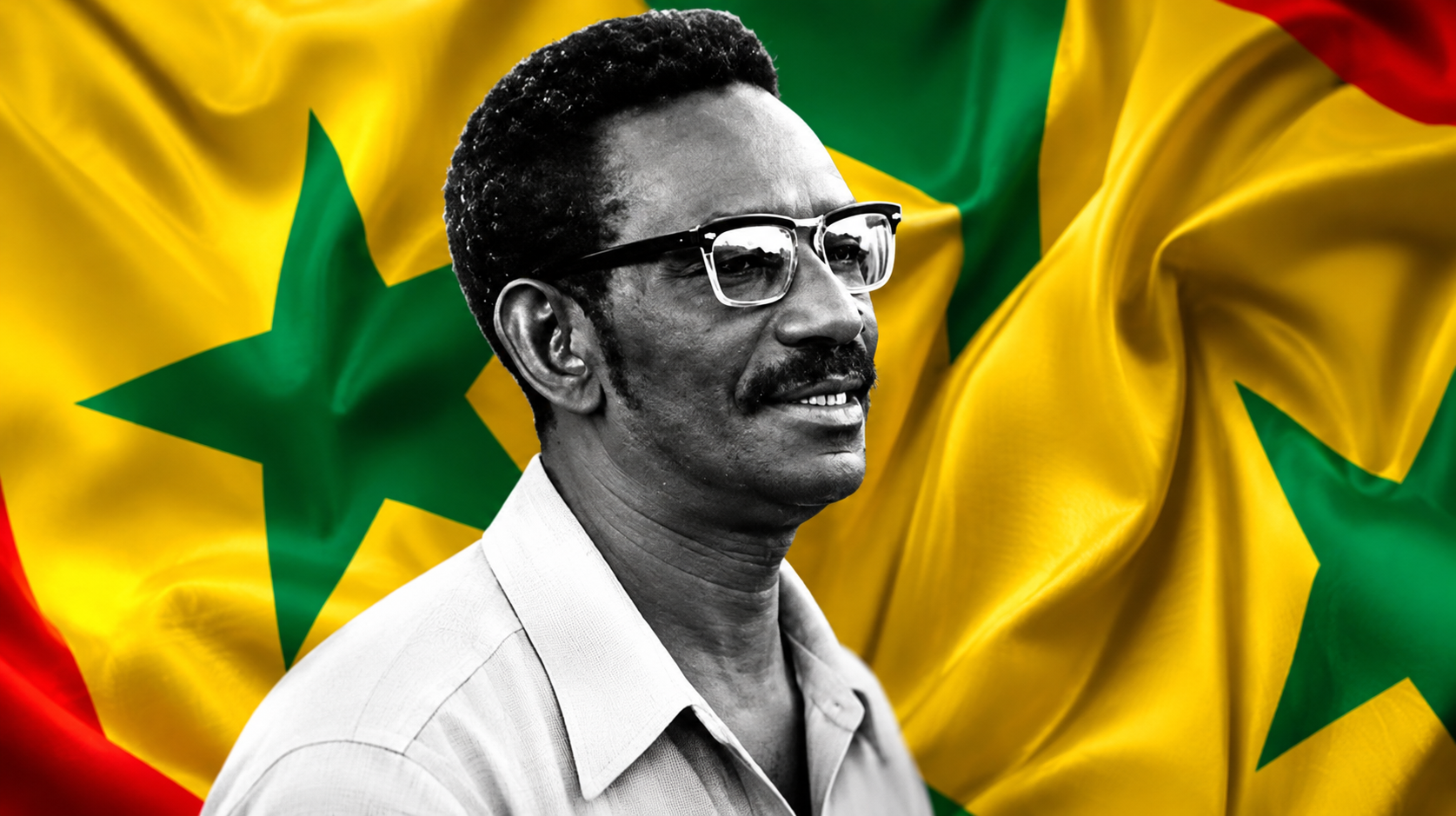
By Moors Media
Hip-Hop has always been a history lesson. Diop gives that lesson a much longer timeline.
Cheikh Anta Diop (1923–1986) was a Senegalese historian, anthropologist and physicist who spent his working life on a single, enormous question: what happens to the story of Africa if you refuse to start it with colonialism? His biography lives on his historical profile. This feature is about the argument he started — what he claimed, what the evidence independently shows, where scholars still disagree, and why the conversation he forced is still going more than half a century later.
A Continent Denied Its History
To understand Diop, start with what he was answering. For much of the nineteenth and twentieth centuries, influential European scholarship treated Africa south of the Sahara as a place without history of its own. In his lectures on the philosophy of history, delivered in Berlin in the 1820s and published after his death in 1837, the German philosopher G. W. F. Hegel described Africa as standing outside the movement of world history — and pointedly detached Egypt from the rest of the continent, as if the pyramids belonged somewhere else.
Those ideas outlived the men who wrote them. Colonial rule needed a justification, and the image of a timeless, unchanging Africa supplied one: if Africans had no past worth recording, conquest could be presented as a "civilizing mission." The pattern showed up in the field as well as the lecture hall. For decades, colonial-era writers credited the stone city of Great Zimbabwe to Phoenicians, Arabs or other outsiders — anyone but the Africans who built it — until the archaeologist Gertrude Caton-Thompson concluded in 1929 that it was African in origin, a finding later work has fully confirmed.
The attitude was still respectable in the 1960s. In a lecture series broadcast by the BBC in 1963 and published as The Rise of Christian Europe, the Oxford historian Hugh Trevor-Roper told his audience:
“"Perhaps in the future, there will be some African history to teach. But, at present there is none: there is only the history of the Europeans in Africa." — Hugh Trevor-Roper, BBC lecture, 1963; published in The Rise of Christian Europe (1965)”
By the time Trevor-Roper said that, Diop had already spent more than a decade proving the opposite was at least worth arguing. Raised in colonial Senegal and educated in both Qur'anic and French colonial schools, he arrived in Paris in 1946, at the age of 23. He did not accept the premise that Africa's past was empty. He suspected the problem was the questions being asked — and who was asking them.
The Scholar Who Asked Different Questions
Diop went to Paris to study physics and chemistry, and he never stopped thinking like a scientist. But he also took on history, Egyptology, linguistics, anthropology and sociology. He attended courses given by the philosopher Gaston Bachelard and later trained in nuclear chemistry in the laboratory of the Nobel laureate Frédéric Joliot-Curie. Along the way he translated parts of Albert Einstein's theory of relativity into Wolof, his first language — a pointed demonstration that an African language could carry modern science as well as French could.
That range became his method. Where specialists tended to stay inside one discipline, Diop tried to build a case from many directions at once: the descriptions of Egypt left by Greek and Roman writers, the art and self-portrayal of the Egyptians themselves, comparisons between ancient Egyptian and living African languages, patterns of kingship, kinship and religion across the continent, physical anthropology and, eventually, laboratory analysis. If several independent lines of evidence pointed the same way, he argued, the conclusion deserved to be taken seriously.
He also turned the question of objectivity around. Colonial scholarship presented itself as neutral, but it had been produced almost entirely by outsiders, often in the service of empire. Diop insisted that African scholars had every right to investigate their own past — and that a history written without them was not neutral, simply incomplete.
The breadth that made his work powerful also made it vulnerable. His critics, then and now, argue that he sometimes moved between fields faster than the evidence in each could support, and that his conclusions were settled before the research began. Even many scholars who disagree with him, however, credit him with something harder to dismiss: he changed which questions African history was expected to answer.
Egypt and the African Historical Continuum
At the center of Diop's work was a thesis he stated without hedging: ancient Egypt was a Black African civilization, and its culture was connected to the rest of Africa. In his view, Egypt was to African history what Greece and Rome are to European history — the classical foundation from which later African societies could be understood. Separate Egypt from Africa, he argued, and African history loses its oldest chapter.
He supported the thesis in several ways. He pointed to ancient authors such as the Greek historian Herodotus, who in the fifth century BCE described the Egyptians as dark-skinned. He read the Egyptians' own name for their country, Kemet, as a reference to its Black population. He compared Egyptian words and grammar with Wolof and other African languages, and he traced parallels in divine kingship, totemism, circumcision and other institutions between the Nile Valley and societies across the continent.
Some of the ground beneath that argument is now firmly established by independent evidence. Ancient Egypt was an African civilization in geography and in its origins: it grew out of Nile Valley and northeast African cultures, with Predynastic societies such as the Naqada culture of Upper Egypt developing many of its later traditions. Egypt was in constant contact with Nubia to its south, and around the eighth century BCE Kushite kings from what is now Sudan ruled Egypt as its Twenty-Fifth Dynasty. The ancient Egyptian language belongs to the Afroasiatic family, which many linguists believe originated in Africa.
Other parts of Diop's case remain contested or are rejected by most specialists. Most Egyptologists translate Kemet as "the black land," a reference to the dark, fertile soil of the Nile floodplain, contrasted with Deshret, "the red land" of the desert. Most linguists do not accept his proposal that ancient Egyptian and Wolof belong to a special shared family. And many biological anthropologists argue that modern racial categories — "Black" or "white" — do not map neatly onto an ancient population that varied from the Mediterranean delta to the southern Nile.
New science has added evidence without ending the debate. A 2017 genetic study of mummies from a single site, Abusir el-Meleq in Middle Egypt, dating from roughly 1400 BCE to 400 CE, found closer affinity with Near Eastern populations than with modern Egyptians. In 2025, researchers published in Nature the first whole genome of an Old Kingdom Egyptian, a man buried at Nuwayrat about 4,500 to 4,800 years ago: most of his ancestry matched earlier North African populations, with about one-fifth matching ancient Mesopotamia. Both studies rest on very few individuals from just two sites, and their authors caution against generalizing them across three thousand years and the full length of the Nile. Genetic ancestry also cannot tell us how ancient Egyptians understood their own identity. These results add evidence to the debate; they do not settle it.
What is no longer seriously disputed is the point Diop most wanted to overturn: the idea that Egypt can be lifted out of Africa and filed with someone else's history. How to describe ancient Egyptians in modern terms is still argued. That Egypt is part of African history is not.
Nations Nègres et Culture
Diop first set out his thesis in a doctoral dissertation prepared at the University of Paris in 1951. It argued that ancient Egypt had been populated by Black Africans and that Egyptian language and culture later spread into West Africa. He was unable to have it accepted for defense. In a French university system that still largely took Europe's account of Africa for granted, the conclusions were treated as unacceptable before they were examined.
He published it anyway. In 1954, Présence Africaine — the Paris journal and publishing house founded in 1947 by the Senegalese intellectual Alioune Diop (no relation), and a home for the leading Black writers of the era — released Nations nègres et culture: de l'Antiquité nègre égyptienne aux problèmes culturels de l'Afrique noire d'aujourd'hui. The subtitle made the ambition plain: from the Black Egyptian past to Africa's cultural problems in the present.
The book was not only about antiquity. Diop argued that a people's understanding of its history was bound up with its future, and that African languages could and should become vehicles for education and science. Published as independence movements gathered strength across the continent, it reached African students and intellectuals hungry for a history that did not begin with conquest. Aimé Césaire, the Martinican poet and politician, praised it in his Discourse on Colonialism as the most daring book a Black writer had ever written. Much of the French academic establishment dismissed it.
Diop kept working inside the system that had refused him. In January 1960 he defended a doctorate at the Sorbonne, building on studies he had published as L'Unité culturelle de l'Afrique noire (1959), which proposed that Africa's societies shared deep cultural roots, and L'Afrique noire précoloniale (1960), a comparative study of precolonial African and European states. In 1967 he returned to his Egyptian thesis in Antériorité des civilisations nègres: mythe ou vérité historique?
English-speaking readers met his argument in 1974, when Mercer Cook — the American scholar and former U.S. ambassador to Senegal — edited and translated major sections of both books as The African Origin of Civilization: Myth or Reality. By then Diop's reputation preceded the translation: according to its publisher, at the First World Festival of Negro Arts in Dakar in 1966, Diop shared with the late W. E. B. Du Bois an award as the writer who had exerted the greatest influence on Black thought in the twentieth century.
The UNESCO Debates
In 1964, UNESCO launched one of the most ambitious scholarly projects of the postcolonial era: a General History of Africa, written largely by African historians, that would tell the continent's story from its own sources and perspectives. Diop was among the scholars working on it. And because the question of ancient Egypt remained so contested, UNESCO convened an international meeting to examine it before the relevant volume was written.
The Symposium on the Peopling of Ancient Egypt and the Deciphering of Meroitic Script met in Cairo from January 28 to February 3, 1974. It brought together specialists from Africa, Europe and North America. Diop and the Congolese historian and linguist Théophile Obenga presented extensive cases for Egypt's African identity, drawing on physical anthropology, iconography, ancient written sources, linguistics and comparative culture. Other participants disputed their conclusions, arguing, among other things, that Egypt's population had been mixed from early times. The published proceedings record the disagreement plainly.
The symposium's own report, published by UNESCO in 1978, also recorded something unusual about how the two sides arrived:
“"[N]ot all participants had prepared communications comparable with the painstakingly researched contributions of Professors Cheikh Anta Diop and Obenga. There was consequently a real lack of balance in the discussions." — General conclusion of the symposium report, in UNESCO, The Peopling of Ancient Egypt and the Deciphering of Meroitic Script (1978)”
Praise for preparation is not agreement, and the report did not declare a winner. Instead, it issued recommendations: international standards for studying human remains, the re-examination of skeletons already held in museums, the study of surviving skin samples, new archaeological work in the Nile Delta and the Sahara, and international cooperation in comparing African languages with ancient Egyptian. In effect, the symposium agreed that the old methods had been inadequate and that the question deserved better science.
Diop then wrote the opening chapter, "Origin of the ancient Egyptians," of Volume II of the General History of Africa, Ancient Civilizations of Africa, edited by the Egyptian scholar Gamal Mokhtar and published in 1981. The symposium's report appears with it, so readers encounter his argument and the objections to it side by side. The symbolism was hard to miss: a thesis that a Paris university would not examine in 1951 now opened a UNESCO history of Africa — presented, fittingly, as part of an open scholarly debate rather than a final verdict.
Science in Service of History
When Diop returned to Senegal in 1960, he joined the Institut Fondamental d'Afrique Noire (IFAN) at the University of Dakar and set about building something the continent badly lacked: a laboratory for radiocarbon dating. Developed by the American chemist Willard Libby in the late 1940s, the technique measures the decay of carbon-14 in organic material to estimate its age, and it had transformed archaeology worldwide. Construction of Diop's laboratory began in 1962, with support from IFAN's directors Théodore Monod and later Vincent Monteil, and it began operating in 1966.
It was among the first radiocarbon laboratories in Africa, and according to IFAN, it played a pioneering role in the region into the early 1980s, dating archaeological samples that helped build chronologies for West Africa's past. In 1968 Diop published an account of its work, Le laboratoire de radiocarbone de l'IFAN. The principle mattered as much as the results: African samples could be analyzed in Africa, by African scientists, rather than shipped abroad for interpretation.
Diop also tried to bring laboratory science to the Egyptian question directly. He developed a method for measuring melanin in skin samples taken from mummies, arguing that it could reveal the pigmentation of ancient Egyptians. This is one of the most disputed parts of his work: other scientists questioned whether pigment could be measured reliably in skin altered by embalming and thousands of years of decay, and the method did not become standard practice. The 1974 symposium's call for further study of surviving skin samples shows that the question was taken up, not that it was resolved.
For Diop, science was a tool of independence. A people that could date its own artifacts, write physics in its own languages and test its own history in its own laboratories was less dependent on anyone else's account of who it was. The genetic studies now reshaping the study of ancient Egypt do not always point where he expected — but they are exactly the kind of evidence he insisted the question deserved.
Beyond the Classroom: Pan-Africanism and Identity
Diop never treated scholarship as separate from politics. As a student in Paris he was active in the anticolonial movement, including the student wing of the Rassemblement Démocratique Africain, and helped organize the first Pan-African student congress there in 1951. In 1956 he spoke at the First International Congress of Black Writers and Artists, organized by Présence Africaine at the Sorbonne, alongside figures including Aimé Césaire, Frantz Fanon and Richard Wright.
His political program was laid out in a 1960 book later published in English as Black Africa: The Economic and Cultural Basis for a Federated State. In it he called for a federation of African states, the use of African languages in education and government, and large-scale development of the continent's energy and industrial resources — arguing that small, separate nations created by colonial borders would remain economically and politically dependent.
At home, those convictions put him in opposition to the government of President Léopold Sédar Senghor. Diop founded the Bloc des Masses Sénégalaises in 1961; the government dissolved the party in 1963. He went on to found the Front National du Sénégal and, in 1976, the Rassemblement National Démocratique. Two of Senegal's most famous intellectuals thus spent years on opposite sides of the country's politics.
Diop's influence traveled furthest through his books. After The African Origin of Civilization appeared in English, his work became foundational for Black Studies scholars in the United States and the Caribbean. The historian Ivan Van Sertima devoted a 1986 volume of the Journal of African Civilizations to him, and the scholar Molefi Kete Asante, a leading theorist of Afrocentricity, has described Diop as a central influence. Théophile Obenga carried forward his linguistic research.
That influence has its own debates. Critics such as the historian Stephen Howe and the classicist Mary Lefkowitz have argued that some popular Afrocentric writing simplified or overstated claims about Egypt, sometimes going well beyond anything Diop himself wrote. Supporters respond that the backlash often targeted the idea of African historical agency itself. Reading Diop directly — rather than through his admirers or his critics — remains the best way to judge him.
The core idea behind it all is one Hip-Hop understands instinctively: identity is built from story, and whoever controls the story shapes what a community believes is possible. Diop's work told generations of Africans and people of African descent that their history was older, deeper and more connected than they had been taught — and that they had the right, and the tools, to investigate it for themselves.
The Long Memory
Recognition came late at home. In the early 1980s Diop was finally appointed professor of history at the University of Dakar. In 1981 he published his final major book, Civilisation ou barbarie: anthropologie sans complaisance, translated in 1991 as Civilization or Barbarism: An Authentic Anthropology. In it he returned to the theme that had organized his whole career:
“"The return to Egypt in all domains is the necessary condition for reconciling African civilizations with history, in order to be able to construct a body of modern human sciences, in order to renovate African culture." — Cheikh Anta Diop, Civilisation ou barbarie (1981); English translation, Civilization or Barbarism: An Authentic Anthropology (1991)”
Cheikh Anta Diop died in Dakar on February 7, 1986. Just over a year later, on March 30, 1987, a decree signed by President Abdou Diouf renamed the University of Dakar the Université Cheikh Anta Diop de Dakar — the same university where his ideas had once been kept at arm's length. IFAN, home of his laboratory, carries his name as well.
His legacy is not a list of settled conclusions. Some of his arguments have been strengthened by later evidence, some have been revised and some have been rejected. What endures is the standard he set: that African history deserves African sources, African languages, African laboratories and African scholars — and that it should be tested with evidence and argued in the open, across many disciplines and points of view.
Long memory is not nostalgia. It is the refusal to let someone else decide where your story begins. Diop pushed the starting line back thousands of years and dared the world to prove him wrong — and the argument he started is still making history.
Read more about his life, works and timeline on the Cheikh Anta Diop historical profile.
Sources and Further Reading
1. Cheikh Anta Diop, Nations nègres et culture: de l'Antiquité nègre égyptienne aux problèmes culturels de l'Afrique noire d'aujourd'hui (Paris: Présence Africaine, 1954).
2. Cheikh Anta Diop, The African Origin of Civilization: Myth or Reality, edited and translated by Mercer Cook (Chicago: Lawrence Hill Books, 1974).
3. Cheikh Anta Diop, L'Unité culturelle de l'Afrique noire (Paris: Présence Africaine, 1959); English edition, The Cultural Unity of Black Africa.
4. Cheikh Anta Diop, L'Afrique noire précoloniale (Paris: Présence Africaine, 1960); English edition, Precolonial Black Africa (Lawrence Hill Books, 1987).
5. Cheikh Anta Diop, Black Africa: The Economic and Cultural Basis for a Federated State (Lawrence Hill Books, 1978; French original 1960).
6. Cheikh Anta Diop, Civilization or Barbarism: An Authentic Anthropology (Lawrence Hill Books, 1991; French original 1981).
7. Cheikh Anta Diop, Le laboratoire de radiocarbone de l'IFAN (Dakar: IFAN, 1968).
8. UNESCO, The Peopling of Ancient Egypt and the Deciphering of Meroitic Script: Proceedings of the Symposium Held in Cairo from 28 January to 3 February 1974, General History of Africa: Studies and Documents 1 (Paris: UNESCO, 1978) — unesdoc.unesco.org
9. G. Mokhtar, ed., General History of Africa, Vol. II: Ancient Civilizations of Africa (Paris: UNESCO; London: Heinemann; Berkeley: University of California Press, 1981), chapter 1, Cheikh Anta Diop, "Origin of the ancient Egyptians," with the symposium report.
10. Institut Fondamental d'Afrique Noire (IFAN) Cheikh Anta Diop, "Carbone 14" laboratory history — ifan.ucad.sn
11. Université Cheikh Anta Diop de Dakar, institutional history; Decree No. 87-382 of March 30, 1987, renaming the University of Dakar.
12. G. W. F. Hegel, Lectures on the Philosophy of History (published 1837).
13. Hugh Trevor-Roper, The Rise of Christian Europe (London: Thames and Hudson, 1965), based on his 1963 BBC lectures; the passage quoted here appears in Kwame Anthony Appiah, "Africa: The Hidden History," The New York Review of Books, December 17, 1998.
14. Aimé Césaire, Discourse on Colonialism (Paris: Présence Africaine, 1955 edition; English translation, Monthly Review Press, 1972).
15. Ivan Van Sertima, ed., Great African Thinkers, Vol. 1: Cheikh Anta Diop, Journal of African Civilizations (1986).
16. Molefi Kete Asante, Cheikh Anta Diop: An Intellectual Portrait (Los Angeles: University of Sankore Press, 2007).
17. Stephen Howe, Afrocentrism: Mythical Pasts and Imagined Homes (London: Verso, 1998).
18. Kathryn A. Bard, "Ancient Egyptians and the Issue of Race," in Mary R. Lefkowitz and Guy MacLean Rogers, eds., Black Athena Revisited (Chapel Hill: University of North Carolina Press, 1996).
19. Verena J. Schuenemann et al., "Ancient Egyptian mummy genomes suggest an increase of Sub-Saharan African ancestry in post-Roman periods," Nature Communications 8 (2017).
20. Adeline Morez Jacobs et al., "Whole-genome ancestry of an Old Kingdom Egyptian," Nature (2025).
21. Encyclopaedia Britannica, "Cheikh Anta Diop."